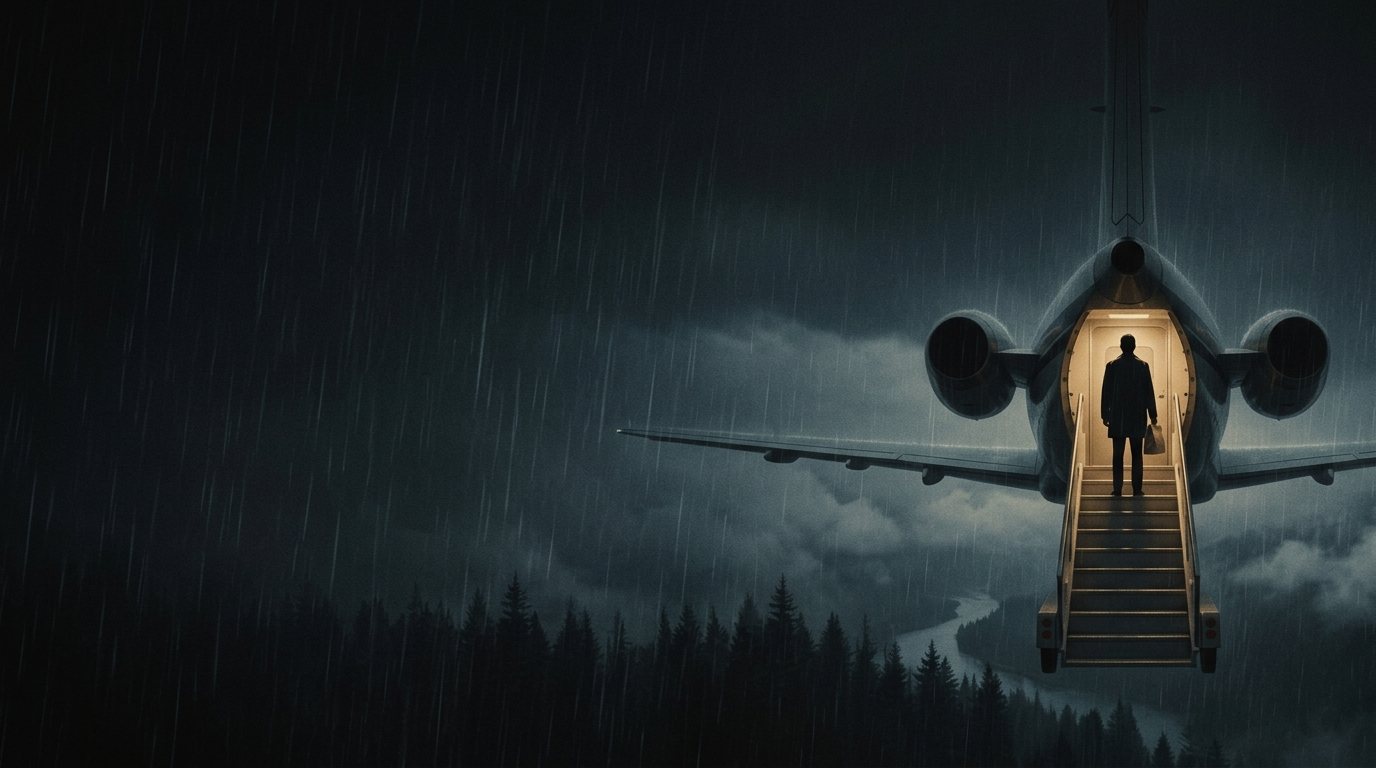
D.B. Cooper: The Man Who Stepped Into the Storm
A calm man, a thirty-minute flight, and a door that opened in the dark.
On the day before Thanksgiving 1971, a quiet man in a dark suit bought a one-way ticket from Portland to Seattle under the name Dan Cooper. Soon after take-off he handed a flight attendant a note saying he had a bomb. By the end of the night he had $200,000 in twenty-dollar bills, four parachutes, and an empty airliner flying low and slow over southwest Washington, with its rear stairs open. At 8:13 pm the tail lifted. He was never seen again.
Timeline
- 24 Nov 1971 · afternoon"Dan Cooper" buys a one-way ticket on Northwest Orient Flight 305, Portland to Seattle, paying cash.
- After take-offHe hands a flight attendant a note saying he has a bomb, and demands $200,000, four parachutes and a fuel truck.
- ~5:45 pmThe plane lands in Seattle. The money (its serial numbers photographed by the FBI) and the parachutes come aboard; the 36 passengers are released.
- ~7:40 pmTake-off again, with four crew. His instructions: slow, below 10,000 ft, landing gear down, flaps at 15°, heading for Mexico via Reno.
- 8:13 pmThe tail suddenly pitches up: the moment most believe he jumped, over southwest Washington.
- ~11 pmThe plane lands in Reno with the stairs still down. He is gone.
- Nov 1978A hunter finds a Boeing 727 rear-stair instruction placard near the flight path.
- 10 Feb 1980An 8-year-old finds $5,800 of the ransom, in rotting bundles, on Tena Bar on the Columbia River. The serial numbers match.
- 8 Jul 2016The FBI suspends its active investigation after 45 years.
Did you know?
Transcript
Read the full transcript
Portland, Oregon. The afternoon of Wednesday, the twenty-fourth of November, nineteen seventy-one. It's the day before Thanksgiving, one of the busiest travel days of the year. And at the Northwest Orient Airlines counter, a quiet man in a dark suit is buying a ticket.
One way. To Seattle. A thirty-minute flight. He pays in cash. And he gives his name as Dan Cooper.
Nobody would remember him for long. He was in his mid-forties, perhaps. Around six feet tall. Dark suit, white shirt, a thin black tie, a black raincoat. He carried a briefcase. And he seemed calm. Polite, even.
Within a few hours, he would be the most wanted man in America. And more than fifty years later, nobody knows who he was.
Flight three-oh-five is a Boeing seven-twenty-seven, a three-engined jet with an unusual feature. Under its tail there is a set of stairs, a stairway that folds down from the back of the plane, so passengers can board at small airports without steps.
Hold on to that detail. It matters.
The man calling himself Dan Cooper takes a seat near the back of the cabin. He orders a drink: bourbon and 7-Up. He lights a cigarette. And shortly after the plane takes off, he calls over a flight attendant, and hands her a note.
She assumes it's a phone number. Men on flights did that. So she drops it into her purse, unread. And he leans towards her, and says quietly that she'd better look at it.
As she later remembered it, the note said something like this.
I have a bomb in my briefcase. I want you to sit by me.
She sits down beside him. He opens the briefcase, just a little, just enough. She sees wires. Red cylinders. A battery. Then he closes it again, and tells her what he wants.
Two hundred thousand dollars. In twenty-dollar bills. Four parachutes: two main, two reserve. And a fuel truck, waiting for the plane when it lands in Seattle.
The message goes up to the cockpit. The pilots radio the ground. And the plane, instead of landing in thirty minutes, begins to circle over Seattle, while on the ground, the airline, the police and the FBI scramble to find two hundred thousand dollars and four parachutes on the evening before Thanksgiving.
The other passengers have no idea. They're told there's a small mechanical problem. A delay. Most of them never see anything unusual at all.
The man in seat eighteen stays calm the whole time. He puts on a pair of dark glasses. He makes small talk. At one point he even offers to have food brought up for the crew. The flight attendant who stayed with him, Tina Mucklow, would later describe him as calm. Not nervous. Not cruel.
Whoever he was, he seemed to know exactly what he was doing.
At about a quarter to six in the evening, the plane finally lands at Seattle-Tacoma airport. It's dark now, and raining. The jet is parked in a remote corner, far from the terminal.
The money arrives in a cloth bag. Ten thousand twenty-dollar bills. And here's a detail that will matter, years later. Before handing it over, the FBI photographs the serial numbers. Every single one.
The flight attendant carries the bag down the aisle to him. Then the parachutes, one trip at a time. He checks everything. And then he keeps his word. He lets all thirty-six passengers go, and two of the flight attendants.
Four people stay on board with him. The three pilots, in the cockpit. And Tina Mucklow.
Then he gives the pilots their instructions. And they are very, very specific.
Head for Mexico City. Fly as slowly as possible without stalling. Stay below ten thousand feet. Keep the landing gear down. Flaps at fifteen degrees. Leave the cabin unpressurised.
The pilots point out that, flying like that, the plane can't possibly reach Mexico. It will need fuel. So they agree to stop in Reno, Nevada. But what the crew notices most is how much he seems to know. About the plane. About how it flies. About exactly what a slow, low seven-twenty-seven with its stairs down would allow a man to do.
At around seven forty, flight three-oh-five takes off again, into the rain and the dark. Somewhere behind it, military jets follow, trying to keep it in sight.
In the cabin, he tells the flight attendant to go up to the cockpit and stay there. She goes. And before the door closes, she sees him one last time: standing in the aisle, tying something around his waist. Then the cockpit door shuts.
He's alone now. Alone in the back of an empty airliner, flying low and slow over the dark forests of southwest Washington.
At about eight o'clock, a warning light comes on in the cockpit. The rear stairs are being lowered.
The crew calls back on the intercom. Is there anything we can do for you? A single word comes back. No.
Then, at thirteen minutes past eight, the pilots feel it. The tail of the plane suddenly lifts, then settles. As if a weight has left the end of the stairs.
Most people believe that was the moment. A man in a business suit, with around twenty pounds of cash tied to his body, stepping off the bottom of those stairs into a freezing, rain-swept night, at well over a hundred miles an hour, somewhere above the forests of southwest Washington.
Nobody saw him go. Not the pilots. Not the military jets. It was too dark, too cloudy, too wet.
The plane flies on through the night, with its stairs still hanging open underneath it. At around eleven o'clock, it lands in Reno. Police and FBI agents surround it. The captain walks back through the cabin.
It's empty. The money is gone. Two of the parachutes are gone. And so is the man who called himself Dan Cooper.
He left very little behind. Eight cigarette butts. A black clip-on tie, with a mother-of-pearl tie clip. And two parachutes. One of them, it turned out, was a dummy: a training parachute, sewn shut. It would never have opened.
And his name? Even that turned out to be wrong. He'd called himself Dan Cooper. But in the rush of that first night, a reporter mixed him up with a different man, a D.B. Cooper, whom police had questioned and quickly cleared. The mistake was printed. It was repeated. And it stuck. The hijacker has been D.B. Cooper ever since.
The search that followed was one of the largest in the region's history. Soldiers, police and FBI agents combed the forests below the flight path. They found nothing. No body. No parachute. No money.
The FBI checked more than a thousand suspects over the years. Every theory had a problem. If he survived, how did he vanish so completely? And if he died, why was nothing ever found?
Then, in February nineteen-eighty, more than eight years later, an eight-year-old boy was playing on a sandy beach on the Columbia River, called Tena Bar, while his family set up a campfire. He was raking the sand flat for the fire, and he found something.
Bundles of money. Old, rotting, falling apart, but still held together by rubber bands. Two hundred and ninety twenty-dollar bills. Five thousand, eight hundred dollars.
The FBI checked the serial numbers against the photographs taken in Seattle, all those years before. They matched.
It was Cooper's money. But it raised more questions than it answered. How did it get there? Carried by the river? Buried by someone? Dropped? And where was the rest of it?
Scientists would later study tiny organisms stuck to the bills, and conclude the money probably hadn't gone into the water in November, when he jumped, but months later. Which only made the mystery deeper.
There was one more find. In nineteen seventy-eight, a hunter in the woods of southwest Washington, near the flight path, picked up a small metal sign. It was the instruction placard for lowering the rear stairs of a Boeing seven-twenty-seven.
And then, nothing.
In July twenty-sixteen, after forty-five years, the FBI announced that it was no longer actively investigating the case, so that it could put its resources into more urgent work. The file, more than sixty volumes of it, is kept at FBI headquarters.
It remains the only unsolved hijacking of its kind in the history of American commercial aviation.
So, what happened to him? Some of the agents who worked the case believed he never survived: that a man in a business suit, jumping at night into freezing rain over thick forest, with a parachute he couldn't steer, simply couldn't have lived. Others believed he landed safely, walked out of the woods, and went home. Maybe even slept in his own bed that night.
The FBI has never said which it believes.
What we do know is this. On the night before Thanksgiving, nineteen seventy-one, a calm, polite man bought a ticket for a thirty-minute flight. He asked for two hundred thousand dollars, and four parachutes. And then he opened a door in the back of an airliner, and stepped out into the dark.
And he was never seen again.
This has been Mystery. The FBI's case files on D.B. Cooper are public. You'll find links to them, and to every source for this episode, on mystery dot app.
Sources
- FBI: D.B. Cooper Hijacking (case history)
- FBI Vault: vault.fbi.gov, search "D.B. Cooper" for the released case file (NORJAK)
- D. B. Cooper, Wikipedia (with references to the FBI file and contemporary reporting)
No suspect is named in this episode. Crew members' words are paraphrased except where the wording is on record.
This is our pilot. The Mystery app is out now: unsolved cases, vanished people, impossible heists and the files nobody closed, as narrated mini-documentaries, new every week.
Download on the App Store