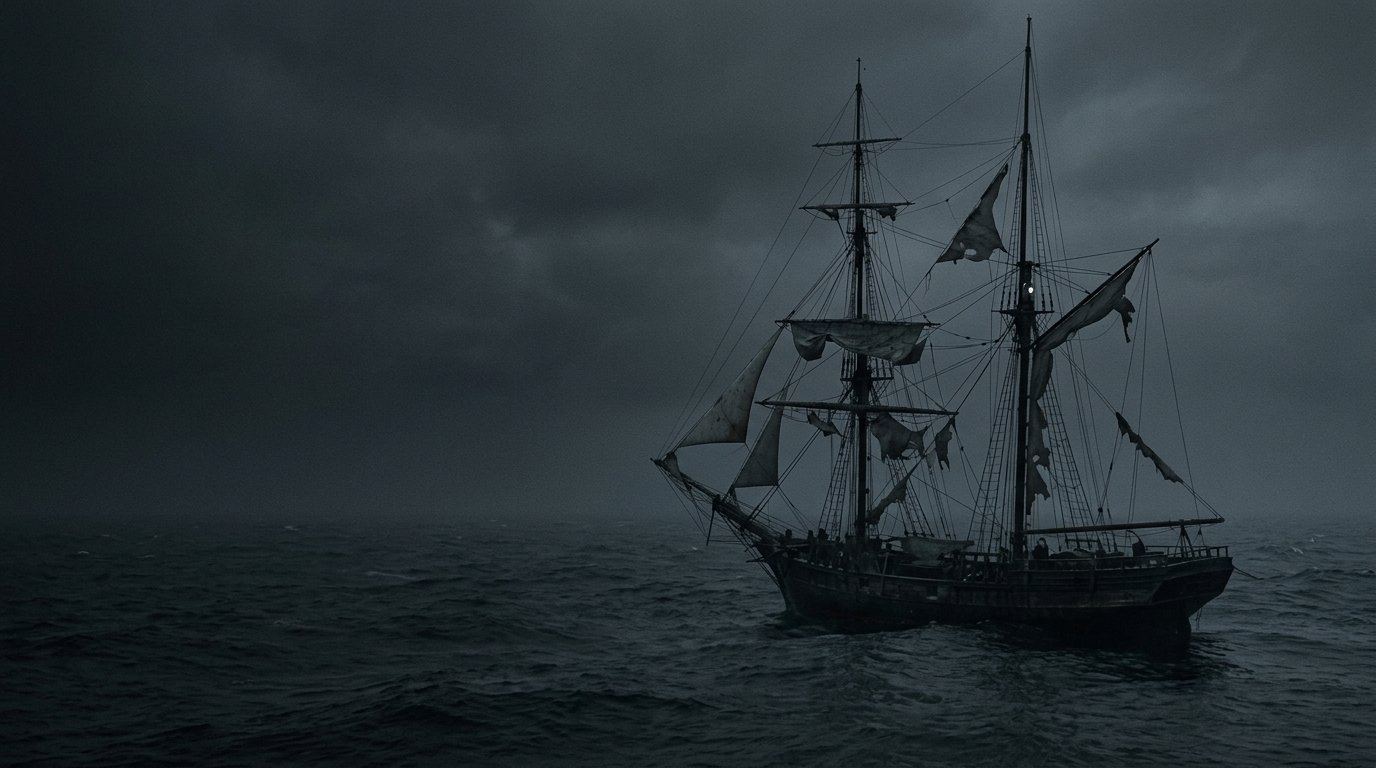
The Mary Celeste: The Ship That Sailed On Alone
December 1872. A ship under sail in the Atlantic. Food, water and cargo aboard. And no one at all.
On 4 December 1872, the crew of the brigantine Dei Gratia found the Mary Celeste drifting between the Azores and Portugal. She was seaworthy, with plenty of food and water and her cargo of 1,701 barrels of alcohol still in the hold. But her only lifeboat, her papers and her captain's instruments were gone, and so were all ten people aboard: Captain Benjamin Briggs, his wife Sarah, their two-year-old daughter Sophia, and seven crew. They were never seen again. A court in Gibraltar suspected murder; the evidence didn't support it. More than 150 years later, the leading explanations are still argued over.
Timeline
- 3 Nov 1872Captain Briggs writes to his mother: "our vessel is in beautiful trim and I hope we shall have a fine passage."
- 7 Nov 1872The Mary Celeste sails from New York for Genoa with 1,701 barrels of alcohol.
- 15 Nov 1872The Dei Gratia leaves New York for Gibraltar.
- 25 Nov 1872 · 8 amLast entry on the log slate, off Santa Maria in the Azores.
- 4 Dec 1872The Dei Gratia finds the Mary Celeste about 400 nautical miles further on, deserted. First mate Oliver Deveau boards her.
- 13 Dec 1872Deveau sails her into Gibraltar. Salvage hearings begin on the 17th.
- 8 Apr 1873The court awards the Dei Gratia's crew £1,700, about a fifth of the value of ship and cargo.
- Jan 1884Arthur Conan Doyle's short story "J. Habakuk Jephson's Statement" turns her into the "Marie Celeste".
- 3 Jan 1885Her last captain deliberately wrecks her on a reef off Haiti for the insurance.
Fact and fiction
Much of what people "know" about the Mary Celeste comes from fiction. Conan Doyle's story had the lifeboats still on board and the ship perfectly watertight; in reality the yawl was missing and there were about three and a half feet of water in the hold. Later retellings added warm tea and a half-eaten breakfast on the table. None of that is in the record of the Gibraltar hearing.
The leading explanations
Two ideas have the most support. One: alcohol leaking from the barrels (nine were found empty at Genoa) gave off fumes, or a small flash of them, and Captain Briggs ordered everyone into the lifeboat until it was safe. Two: a faulty pump or a false sounding made him believe the ship was sinking, and he abandoned her, taking the instruments and papers. In both, the lifeboat and the ship were separated and never reunited. Neither can be proved. Murder, mutiny and a salvage conspiracy have all been suggested; there is no evidence for any of them.
Transcript
Read the full transcript
The North Atlantic. December, eighteen seventy-two. Somewhere between the Azores and the coast of Portugal, a small sailing ship is moving across the sea.
Her sails are only partly set. Some are torn. She's yawing, swinging off course and back again, like no one is steering her. Because no one is.
Her name is the Mary Celeste. And for more than a hundred and fifty years, nobody has been able to say for certain what happened to the ten people who sailed on her.
A month earlier, she's tied up at Pier Fifty, on the East River in New York, taking on cargo. One thousand, seven hundred and one barrels of alcohol, bound for Genoa, in Italy.
Her captain is Benjamin Briggs. Thirty-seven years old, from Massachusetts. A careful man, from a family of sea captains. And this time, he isn't sailing alone.
His wife, Sarah, is coming with him. So is their daughter, Sophia. She's two. Their son, Arthur, who's seven stays at home with his grandmother.
There's a first mate, a second mate, a cook and steward, and four German sailors, described as peaceable, first-class seamen. Ten people in all.
Just before they sail, the captain writes to his mother.
Our vessel is in beautiful trim, and I hope we shall have a fine passage.
On the seventh of November, eighteen seventy-two, the Mary Celeste leaves New York, and heads out into the Atlantic.
Eight days later, another ship leaves the same port. The Dei Gratia, a Canadian brigantine, bound for Gibraltar. Her captain is David Morehouse. Her first mate is a tough, experienced Nova Scotian called Oliver Deveau.
They're about to find something no sailor wants to find.
The fourth of December. Early afternoon. The lookout on the Dei Gratia spots a sail. As they close in, something looks wrong. She's on a strange course. Her sails are in a mess. And there's no one on deck. No one at the wheel.
They signal. There's no reply.
So Oliver Deveau and another sailor lower a small boat, and row across.
They climb aboard. And they search the ship, from end to end.
There is nobody there.
The ship's only lifeboat, a small boat called a yawl, is gone. The ship's papers are gone. So are the captain's navigation instruments: his chronometer, his sextant. Two hatches are open. And there's water in the hold. About three and a half feet of it.
That sounds like a lot. But for a ship this size, it isn't dangerous. She is not sinking. She's seaworthy. Deveau would go on to sail her all the way to Gibraltar.
There's plenty of food. Plenty of fresh water. The cargo is still in the hold. In the cabins, the crew's belongings are still there: their clothes, their boots, their sea chests. Under the captain's bed, there's a sword in its scabbard.
And there's no sign of a fight. No sign of fire. Ten people have simply gone.
And then there's the log. The captain's notes were kept on a slate, to be copied into the logbook later. The last entry is from the morning of the twenty-fifth of November. Off the island of Santa Maria, in the Azores.
At eight, eastern point bore south-south-west, six miles distant.
That's it. Nothing after that. And yet the ship is found nine days later, around four hundred miles further on. She'd been sailing on, by herself, with no one aboard.
Deveau brings the Mary Celeste into Gibraltar. And the British authorities there hold a hearing, to decide on salvage. How much the Dei Gratia's men should be paid, for bringing her in.
The man asking the questions is Gibraltar's Attorney General, Frederick Solly-Flood. And he doesn't like what he sees.
He has a theory. The crew got into the alcohol. They got drunk, killed the captain and his family, and escaped in the lifeboat. He points to cuts on the bow, and to stains he believes are blood.
But the stains are tested. They're not blood. And no trace of the crew, or the lifeboat, is ever found.
Some people even suspected the rescuers. That the two crews had planned it together, for the salvage money. There's no evidence for that at all. In the end, the court pays the Dei Gratia's crew seventeen hundred pounds. About a fifth of what the ship and her cargo were worth. Less than they'd hoped. And the mystery stays open.
So what happened? Over the years, a few explanations have come up again and again.
The first is about the cargo. When the Mary Celeste finally reached Genoa, and the barrels were unloaded, nine of them were empty. Alcohol had leaked into the hold. And alcohol gives off fumes.
Captain Briggs's own cousin believed that fumes, or a small explosion of them, had frightened the captain into ordering everyone off the ship. Into the lifeboat. Just until it was safe.
In two thousand and six, a chemist built a model of the hold and tested the idea, using a flammable gas. It lit with a sudden flash of flame. It was frightening. But it was cool enough that it didn't scorch or burn anything at all.
The second explanation is simpler. A pump on the Mary Celeste had been taken apart. And there was a makeshift sounding rod lying on deck: a stick, for measuring how much water is in the hold.
Perhaps, after a storm, or a waterspout, the captain measured the water, and believed his ship was going down. And with his wife and his two-year-old daughter aboard, he didn't wait.
He took the instruments and the papers, put everyone in the little yawl, and pulled away. Maybe they meant to stay close, tied on behind with a rope. And maybe the rope parted. And the ship, which was never sinking at all, sailed on without them.
It's a theory. There's no proof. But it would explain why everything was left so neatly. Why nothing was stolen. Why there was no fight.
It doesn't explain everything. Why a careful, experienced captain would leave a sound ship. Or what happened to ten people, in a small open boat, hundreds of miles from land.
And then, eleven years later, a young British doctor, who wanted to be a writer, turned the story into fiction. His name was Arthur Conan Doyle. A few years before he created Sherlock Holmes.
He changed the ship's name to the Marie Celeste. And he made the mystery even stranger.
She is perfectly watertight. No signs of a struggle or of violence are to be detected, and there is absolutely nothing to account for the disappearance of the crew.
In his story, the lifeboats are still on board. They weren't. In real life, the boat was gone. But people believed the story. And over the years, other writers added more. Warm cups of tea still on the table. A half-eaten breakfast. None of that is in the record. But it's the version most people remember.
As for the ship herself. She sailed on for another twelve years. Then, in eighteen eighty-five, her last captain ran her onto a coral reef off Haiti. On purpose. For the insurance money. The fraud was uncovered, and it ruined him.
The wreck of the Mary Celeste is still out there somewhere.
Captain Briggs, Sarah, little Sophia, and the seven men who sailed with them were never seen again. Back in Massachusetts, their son Arthur grew up without them.
So what happened on the Mary Celeste? Fumes from the cargo? A captain who thought his ship was sinking? Or something that a log slate, a court in Gibraltar, and a hundred and fifty years of searching still haven't explained?
The file is open. You decide.
This has been Mystery. Every source for this episode is on mystery dot app.
Sources
- Records of the Vice-Admiralty Court of Gibraltar salvage hearings, Dec 1872 to Apr 1873, as summarised by Charles Edey Fay, Mary Celeste: The Odyssey of an Abandoned Ship (1942), and later historians
- The log slate's last entry, as reported in contemporary accounts (e.g. US Library of Congress newspaper archive)
- Arthur Conan Doyle, "J. Habakuk Jephson's Statement", Cornhill Magazine, January 1884 (Wikisource)
- The mystery of the Mary Celeste, Royal Museums Greenwich
- Mary Celeste, Wikipedia
Quotations from the captain's letter, the log slate and Conan Doyle's story are read verbatim. Conan Doyle's story is fiction.
The Mystery app is out now: unsolved cases, vanished people, impossible heists and the files nobody closed, as narrated mini-documentaries, new every week.
Download on the App Store