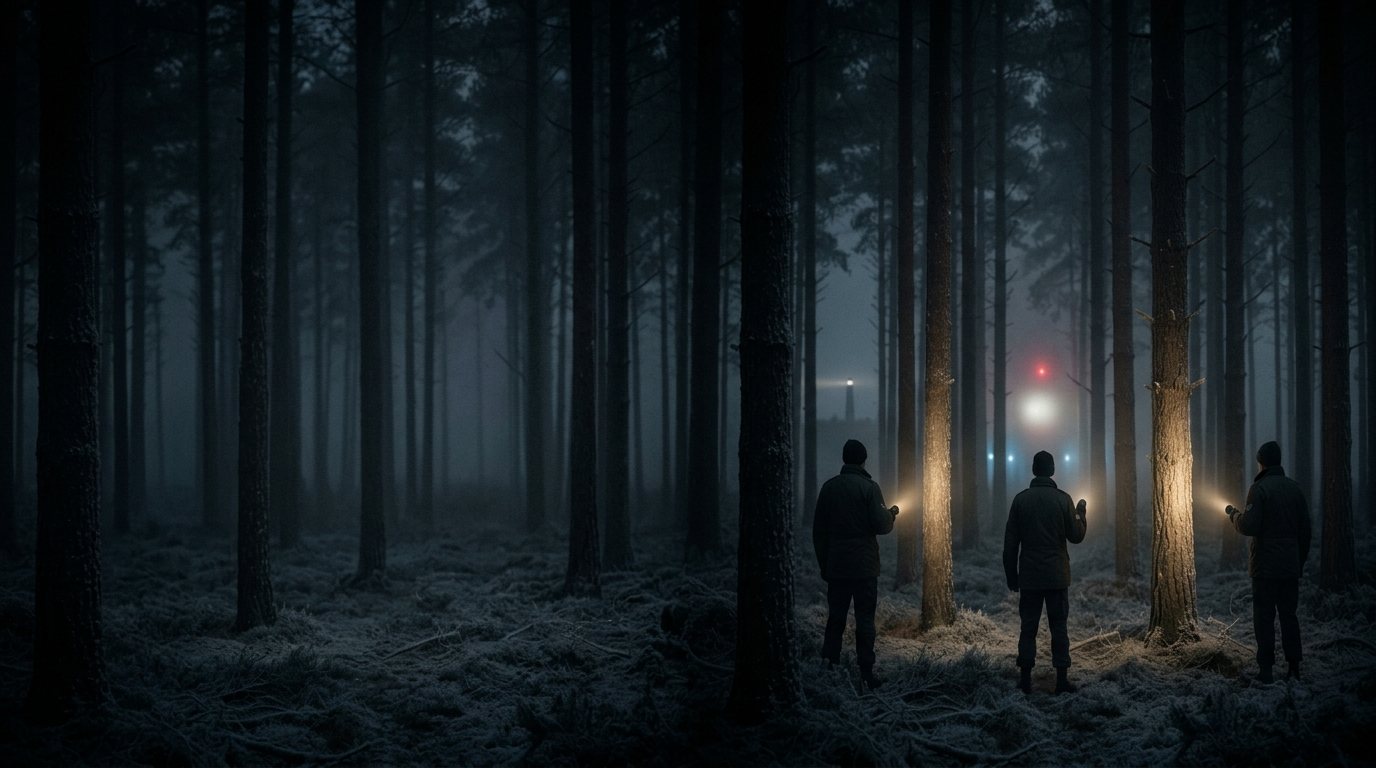
Rendlesham Forest: The Lights Among the Trees
Christmas 1980. A Cold War air base. And a memo signed by its deputy commander.
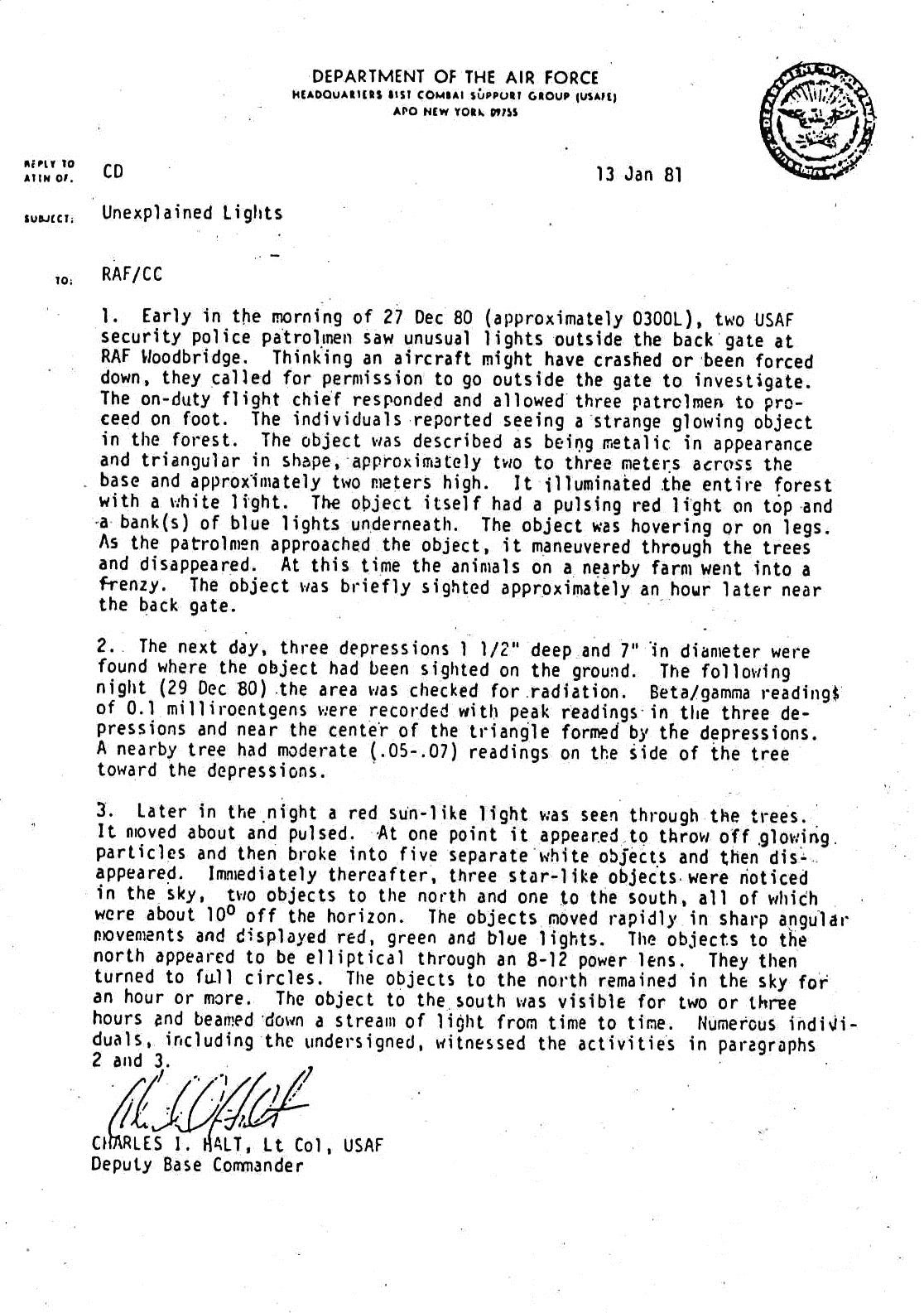
In the early hours after Christmas Day 1980, a security patrol at RAF Woodbridge in Suffolk, a base run by the US Air Force, saw lights coming down into Rendlesham Forest. Three airmen went in on foot. Two nights later the deputy base commander, Lieutenant Colonel Charles Halt, led a team into the forest himself, with a radiation detector and a tape recorder. His official memo, titled simply "Unexplained Lights", made Rendlesham Britain's most famous UFO case. The sceptics' answer has always pointed to a lighthouse a few miles away.
Timeline
- 26 Dec 1980 · ~3 amA patrol at RAF Woodbridge's back gate sees lights descending into the forest. Three airmen go in on foot and report a glowing object among the trees.
- After 4 amLocal police attend. The only light they report is the Orford Ness lighthouse.
- Next dayThree small depressions are found in a clearing. Police and a forester think they are rabbit diggings.
- Early 28 DecLt Col Halt leads a team into the forest with a Geiger counter and records the night on a pocket tape recorder.
- 13 Jan 1981Halt's memo, "Unexplained Lights", goes to the RAF commander on the base and on to the Ministry of Defence.
- 1983The memo is released in the US under the Freedom of Information Act, and soon makes the front page of a British Sunday newspaper.
- 2008-2013The Ministry of Defence's UFO files are released to the UK National Archives.
- TodayA Forestry Commission UFO trail runs through the forest.
Halt's memo dates the events a day later (27 and 29 December); most accounts place them on the 26th and 28th.
The memo
The sceptics' explanation
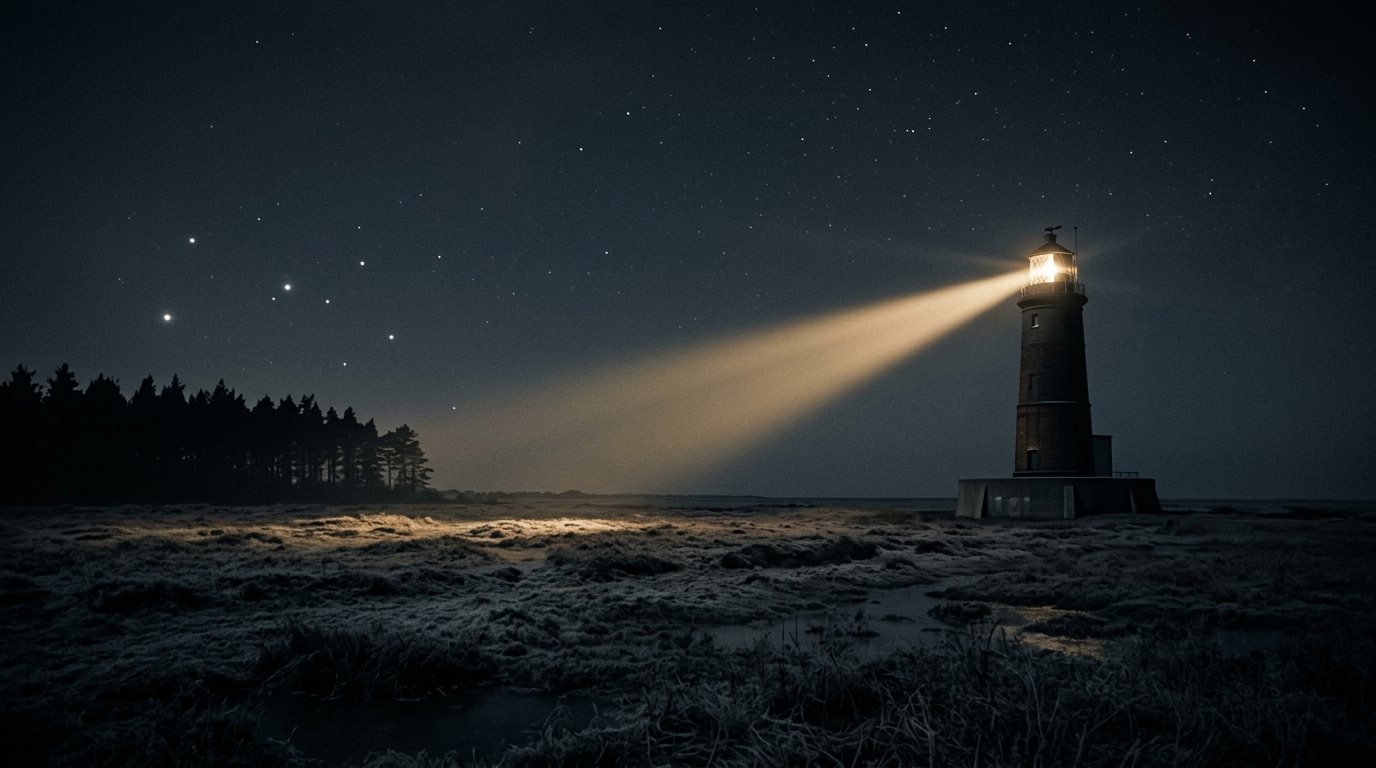
The writer Ian Ridpath proposed three ordinary causes: a bright meteor seen over southern England at about the time of the first sighting; the Orford Ness lighthouse, a few miles east and flashing every five seconds; and bright stars low on the horizon for the "star-like objects". Some witnesses reject this. The episode sets out both sides.
Transcript
Read the full transcript
Suffolk, England. Christmas, nineteen eighty. On the east coast, a few miles from the sea, there's a dark pine forest called Rendlesham. And on its edge, behind high fences, sit two air bases: RAF Woodbridge and RAF Bentwaters.
They're Royal Air Force stations in name. But this is the height of the Cold War, and the people who run them are American. The United States Air Force. Fighter jets. Security patrols. Thousands of servicemen and their families, spending Christmas a long way from home.
And in the small hours of the morning after Christmas Day, something happened in that forest that has never been properly explained.
It's around three in the morning. A security patrol near the back gate of RAF Woodbridge sees lights. Lights coming down, into the trees. Their first thought is the obvious one. An aircraft. Crashed, or forced down in the forest.
They radio for permission to go outside the base and look. It's granted. And three airmen head out on foot, into Rendlesham Forest, in the dark.
What they reported seeing was later set down in an official memo, written by the base's deputy commander. This is what it says.
The individuals reported seeing a strange glowing object in the forest. The object was described as being metallic in appearance and triangular in shape, approximately two to three meters across the base and approximately two meters high. It illuminated the entire forest with a white light.
The object itself had a pulsing red light on top and a bank of blue lights underneath. The object was hovering or on legs. As the patrolmen approached the object, it maneuvered through the trees and disappeared.
The memo adds one more detail. At that moment, the animals on a nearby farm went into a frenzy.
The airmen came back to base shaken. The local police were called, and officers drove out to the forest a little after four in the morning. They looked. And the only light they reported seeing was the beam of a lighthouse, flashing on the coast at Orford Ness, a few miles away.
Remember that lighthouse. It's going to matter.
In daylight, the airmen went back to the spot where they'd seen the object. And there, in a small clearing, they found marks in the ground.
The next day, three depressions, one and a half inches deep and seven inches in diameter, were found where the object had been sighted on the ground.
Three marks. In a triangle. The police came to look at those too. They weren't impressed. To them, and to a local forester, the marks looked like the diggings of rabbits.
It might have ended there. A strange night. A report. A few holes in the ground. But two nights later, the lights came back.
And this time, the man who went into the forest was the deputy commander of the base himself. Lieutenant Colonel Charles Halt.
Halt took a small team, a radiation detector, and a pocket tape recorder. He intended, he said, to put the story to rest.
They found the clearing, and the three marks. They measured for radiation. Halt's memo records the result.
Beta, gamma readings of zero point one milliroentgens were recorded, with peak readings in the three depressions and near the center of the triangle formed by the depressions.
To be fair, sceptics would later point out that readings like that are very low. Close to the natural background level you'd find almost anywhere. But that night, in the dark, with the counter clicking, it didn't feel like background.
Because then they saw it.
Later in the night a red sun-like light was seen through the trees. It moved about and pulsed. At one point it appeared to throw off glowing particles, and then broke into five separate white objects, and then disappeared.
And then, in the sky, more lights.
Three star-like objects were noticed in the sky, two objects to the north and one to the south. The objects moved rapidly in sharp angular movements and displayed red, green and blue lights. The object to the south was visible for two or three hours, and beamed down a stream of light from time to time.
And then Halt adds a single line that has kept this case alive ever since.
Numerous individuals, including the undersigned, witnessed the activities.
Including the undersigned. Not a rumour. Not a story told in a pub. A senior United States Air Force officer, putting his name to it.
Halt's memo was dated the thirteenth of January, nineteen eighty-one. Its subject line was just two words: Unexplained Lights. He sent it to his British counterpart on the base, and it went on to the Ministry of Defence in London.
And then, for more than two years, almost nothing.
Until nineteen eighty-three, when a copy was released in America under the Freedom of Information Act. Within months, it was on the front page of a British Sunday newspaper. And Rendlesham Forest became one of the most famous UFO cases in the world.
So what did the British government make of it? For years, the Ministry of Defence's position came down to this.
The event posed no threat to national security, and was therefore never investigated as a security matter.
No threat. So, no investigation. To believers, that sounded like a door being closed. To sceptics, it sounded like exactly what it said.
Which brings us back to the lighthouse. A British writer, Ian Ridpath, spent years going through the evidence. And he put forward a very down-to-earth explanation, in three parts.
First: at almost the exact time of the first sighting, a very bright meteor, a fireball, had streaked across the sky over southern England. Lights coming down into the trees.
Second: the Orford Ness lighthouse. A few miles to the east, in the same direction as the forest, flashing every five seconds. Seen through the trees, at night, by men already on edge, a flashing light that seems to move as you walk.
And third: the star-like objects in the sky. Bright stars, low on the horizon on a cold, clear winter night, twinkling red and green and blue.
Some of the witnesses themselves later said that, on one of the nights, they'd followed a light through the forest for a long way, before realising it was coming from the lighthouse.
Others have never accepted that. They say they know what they saw. That trained security personnel can tell a lighthouse from a craft. And in the years since, some witnesses have gone further, with new and more extraordinary accounts that weren't part of the original statements.
The memo, on its own, doesn't settle it either way. It records what men said they saw. It records three marks and some very low readings. It doesn't say what any of it was.
In the early nineteen nineties, the Americans left. But the forest is still there.
Today, you can walk a UFO trail through Rendlesham Forest, laid out by the Forestry Commission, past the spot where it all began. At the end of it there's a strange metal sculpture of the object, as the airmen described it. Families walk it on Sunday afternoons.
And some of them, on the way back to the car park, can't help glancing east. Towards the coast. Towards a light, flashing every five seconds.
So what came down into Rendlesham Forest, in the early hours after Christmas, nineteen eighty? A meteor, a lighthouse and some bright stars? Or something that three airmen, a deputy base commander, and numerous individuals still cannot explain?
The file is open. You decide.
This has been Mystery. Lieutenant Colonel Halt's memo, and every source for this episode, are on mystery dot app.
Sources
- Lt Col Charles I. Halt, memorandum "Unexplained Lights", 13 Jan 1981 (released under the US Freedom of Information Act, 1983). Scan on Wikimedia Commons
- UK National Archives: Ministry of Defence UFO files (released 2008-2013)
- Ian Ridpath's investigation of the case (ianridpath.com)
- Rendlesham Forest incident, Wikipedia

Many of the witnesses are alive. This episode quotes the official record and doesn't claim to know what they saw.
The Mystery app is out now: unsolved cases, vanished people, impossible heists and the files nobody closed, as narrated mini-documentaries, new every week.
Download on the App Store